

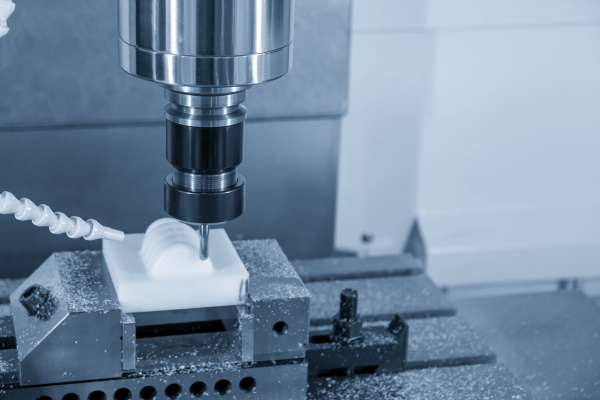
CNC plastic machining can produce clean, precise, high-performance components with consistent results. Plastic materials are cost-effective and lightweight, providing versatile solutions for custom components across various industries, including medical, aerospace, defense, and industrial applications. We offer an array of capabilities, such as producing plastic prototypes with real-world material benefits, making quick design changes, and delivering tight tolerances to meet your application requirements.
The primary difference between CNC plastic machining and metal machining is how the materials react to the process. Plastics are softer than metals, so they are more sensitive to the heat generated by CNC machining operations; managing speed and heat is essential, as plastics can melt. They can also deflect under tool pressure, making fixturing and toolpaths critical for minimizing stress. It is a more cost-effective process and can offer additional benefits because of the material properties plastics offer over metals.
The best plastic for CNC machining depends on the properties of the chosen material. It is essential to consider the resistance to heat, chemicals, wear, moisture, and friction, as well as the dimensional stability and strength of the material and its requirements for the final application.
An engineering-grade thermoplastic, Delrin is known for its strength, durability, and low friction properties. It maintains its shape and performance under stress, making it an ideal material for mechanical components.
With strong resistance properties, UHMWPE is an engineered thermoplastic that performs well in harsh environments. It meets FDA and USDA requirements for food contact, with chemical inertness and non-porosity, providing a favorable material for implants, food and beverage device components, and medical device components.
A low-friction polymer that is strong and stiff, acetal is dimensionally stable across a wide temperature range. It is an ideal choice for moving parts and components, such as pump parts, housings, and surgical instruments.
With excellent properties, including high strength, thermal stability, and chemical resistance, PEEK is a lightweight, low-friction material. It can be machined to tight tolerances for high-wear applications, making it an ideal option for medical, industrial, automotive, and aerospace components.
With experience machining a wide range of plastic materials, we provide precision plastic machining for high-quality precision parts for medical implantable devices and surgical instruments. Components that can be made by CNC machining plastic include, but are not limited to:
For aerospace, defense, and industrial applications, CNC-machined plastic parts reduce overall weight while maintaining structural integrity. Precision plastic machining delivers high-quality components made to exact specifications, ensuring parts fit together and function reliably in mission-critical environments. Components for aerospace, defense, and industrial markets that are produced with CNC plastic machining include:
With over 75 years of precision machining experience, Marver Med is ISO 13485:2016 certified and ANSI compliant, offering CNC plastic machining services to meet application specifications. We utilize rigorous quality assurance practices to ensure your finished components are made to exact requirements, providing capabilities to work with a wide range of specialty materials for high-performance solutions. For examples of our work, visit our plastic machining gallery, contact us to discuss your project, or request a quote to begin.
Acetal is considered the best plastic for CNC machining because of its balanced material properties and excellent machinability. It offers the best material option for precise, tight tolerances and features dimensional stability, high stiffness, and low friction.
When choosing a plastic for CNC milling or turning processes, consider the material’s properties, as well as the requirements of the final product to ensure it will be a viable option.
Yes, CNC machining is an effective process for producing plastic prototypes, providing a more cost-effective solution to expensive molding operations.

ISO 13485:2016 Certified and ITAR Compliant

| Certifications | ||
 |
 |
 |